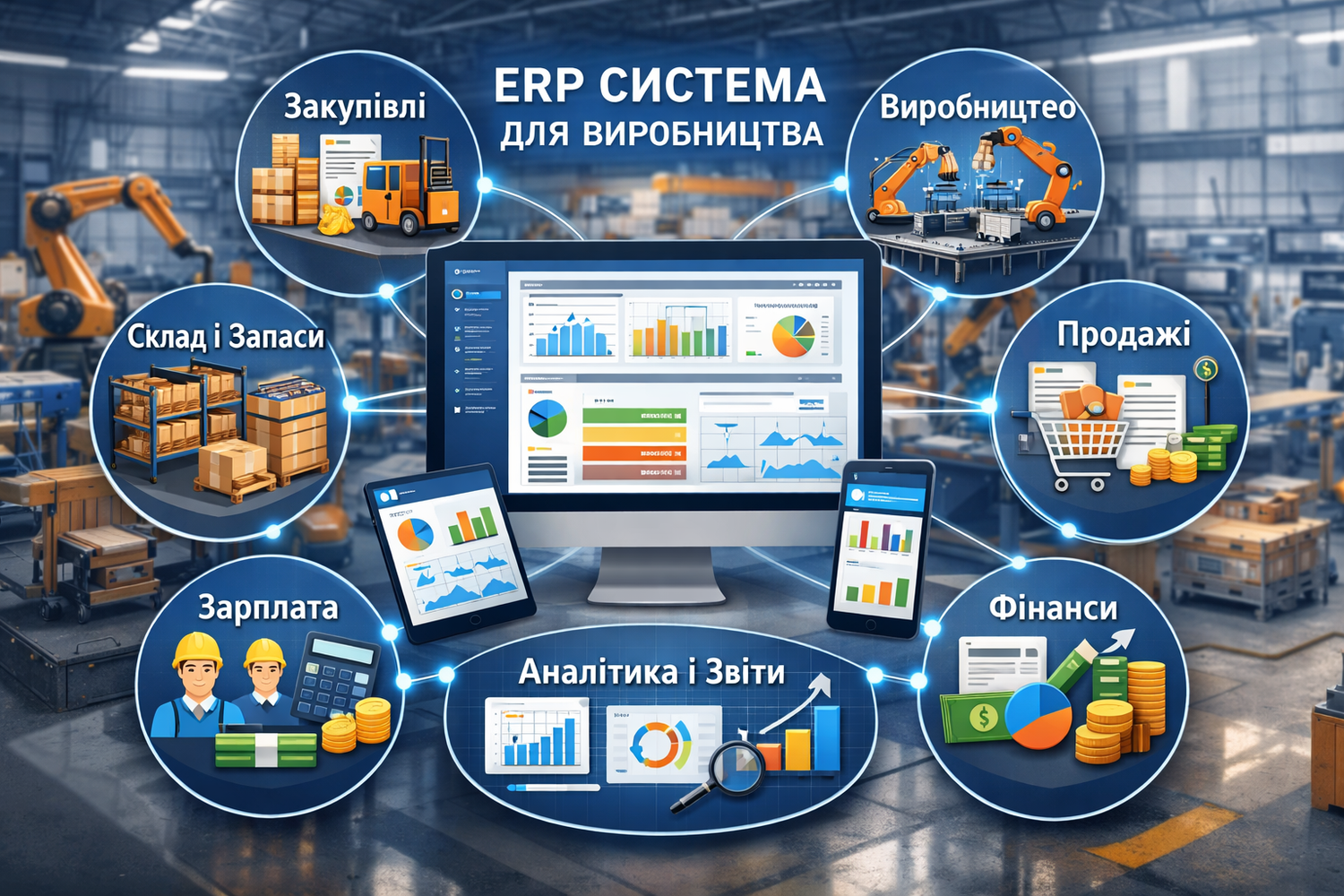
In manufacturing companies with 20–100 employees, a set of separate tools is usually used: warehouse software, accounting systems, spreadsheets for production, and separate payroll calculations. Formally, accounting exists, but management begins to operate “manually”.
At this stage, the manager starts managing not the system, but people: calling the warehouse, checking with production, asking the accountant to “calculate it again”. This is a signal that the accounting tools no longer match the scale of the business.
The manager sees different inventory balances in different systems, costs are calculated approximately, procurement does not know the real demand, and production regularly stops due to “unexpected” raw material shortages. This is a typical situation for a mid-sized manufacturing business.
Below is a simple explanation of why warehouse accounting and accounting software do not cover manufacturing management — and what an ERP system actually provides.
The Problem of Disconnected Systems: No Single Source of Truth
When procurement, warehouse, production, and sales are managed in different systems, each department sees its own version of balances, needs, and results. The manager is forced to manually consolidate the picture — and almost always with delays.
Practical scenario:
A manufacturing company with 40 employees manages warehouse operations in retail software, production in Excel, and accounting in a separate system. Cost calculation is performed once a month by the accountant.
After three months, it turns out that two main products were sold below their actual cost. The reason — actual raw material consumption was 7–10% higher than the standard, but this became visible only after the period was closed.
Revenue was growing. Profit was not.
This is not a people problem. This is a disconnected systems problem.
Such situations occur not because employees are incompetent. They arise when production processes are not connected within a single model.
ERP does not “add another program” — it removes the gap between stages.
Typical Business Consequences
- Costs become distorted. Materials, operations, and expenses are not consolidated into a single model — real profitability is unknown.
- Production stops due to raw material shortages. The warehouse shows stock, but part of it is already “verbally reserved”, and procurement does not see this.
- Constant manual reconciliations. Accounting reconciles with warehouse, warehouse with production, production with procurement — and the manager reconciles everyone.
- Different numbers — different decisions. There is no single answer to how much raw material is available, what is in production, when it will be ready, and what actually generates profit.
As a result, the company has accounting but lacks manageability. ERP is needed exactly where not only post-factum records matter, but real-time process management.
Why Warehouse Accounting Does Not Solve Manufacturing Challenges
Warehouse accounting answers the questions “what is available and where it is located” and “what was moved and where”. For trade businesses this is often sufficient. For manufacturing — it is not, because key events occur between “raw materials taken” and “finished product received”.
It is at this stage that profit or loss is formed. Even a 5–8% deviation in material consumption standards with stable production volumes can “eat up” 20–30% of planned margin. Without systematic control, these deviations become permanent.
What Warehouse Accounting Does Well
- shows inventory balances and material/product movements;
- records receipts, write-offs, transfers;
- often supports batches (at a basic level);
- works with sales (if it is retail-oriented software).
What Usually Falls Outside Without ERP
- Production operations and stages: execution control, deadlines, work in progress.
- Technology: BOMs/recipes, consumption standards, finished goods output.
- Cost calculation: production wages, energy costs, overhead, losses, defects.
- Planning: whether there will be enough raw materials for orders, what to purchase, when, and in what quantity.
Management conclusion: warehouse systems answer “what do we have”. ERP answers “how does production operate and are we making money”.
Why Accounting Software Also Does Not Replace ERP
An accounting system is necessary for statutory accounting and reporting. But its logic is to record the fact of an operation and summarize the result. Manufacturing needs management tools: planning, reservations, stage control, deviations from standards.
What Accounting Handles Well
- accounting, VAT, and reporting;
- control of funds and settlements (within regulatory accounting);
- summary indicators “for the period”.
What Remains a Weak Point for Manufacturing
- Operational speed: production needs data “for tomorrow”, not only “for last month”.
- Detail level: actual material consumption, stages, WIP, losses, defects.
- Demand planning: reservations, requirement calculations, batch and expiry control.
Management conclusion: accounting answers “what has already happened”. ERP helps answer “what will happen and what should we do today”.
Accounting is a recording tool. ERP is a management tool.
That is why accounting cannot be the core of a manufacturing system.
What ERP Means for a Manufacturing Company
ERP for manufacturing is a single system that connects procurement, warehouse, production, sales, and finance into one management model. The key difference is not just recording operations, but managing processes: planning, execution control, transparent cost calculation, and profitability.
What Manufacturing ERP Should Include
- Procurement: demand planning, price control, supplier management.
- Technology: BOMs, recipes, standards, stages.
- Costing: materials, production costs, overhead, losses, defects.
- Batches and expiry dates: traceability, write-offs, quality control.
- Production tasks: plan vs fact, deadline control, WIP.
- Analytics: product and order profitability, bottlenecks, cost structure.
For example, in cosmetics manufacturing, batch and expiry control is critical. In garment production — variability management (sizes, colors, series). In food production — consumption accuracy and loss control. ERP allows you to manage these specifics without breaking the connection between warehouse and production.
If you want to see what ERP for manufacturing looks like in a real product, check out Skynum — cloud ERP system for manufacturing businesses.
Comparison of Accounting Systems for Manufacturing
Capabilities |
Warehouse Accounting |
Accounting Software |
Manufacturing Software |
ERP Skynum |
|---|---|---|---|---|
Inventory and Movements |
✅ |
⚠️ |
⚠️ |
✅ |
Production Operations |
❌ |
❌ |
✅ |
✅ |
Production Technology |
❌ |
❌ |
✅ |
✅ |
Product Costing |
❌ |
⚠️ |
⚠️ |
✅ |
Production Expenses |
❌ |
⚠️ |
⚠️ |
✅ |
Production Planning |
❌ |
❌ |
✅ |
✅ |
Material Requirements Planning |
❌ |
❌ |
⚠️ |
✅ |
Material Reservation |
❌ |
❌ |
⚠️ |
✅ |
Work in Progress |
❌ |
⚠️ |
✅ |
✅ |
Financial Settlements |
❌ |
✅ |
⚠️ |
✅ |
Financial Reporting |
❌ |
✅ |
❌ |
✅ |
Single Source of Data |
❌ |
❌ |
❌ |
✅ |
Enterprise Management |
❌ |
❌ |
⚠️ |
✅ |
When a Manufacturing Company Truly Needs ERP
ERP becomes necessary if several of the following apply to your business:
- in-house production and regular manufacturing orders;
- batches of raw materials and/or finished goods, expiry control;
- multiple production stages or work in progress;
- warehouse (or several warehouses) and active material movement;
- 20–30+ employees and departmental role distribution;
- complex costing structure (materials, labor, energy, overhead, losses);
- constant data discrepancies between departments.
Key Management Conclusions
- Warehouse accounting helps control inventory but does not manage the production cycle.
- Accounting software is necessary for reporting but does not provide operational control.
- Separate systems almost always create duplication of work and discrepancies in figures.
- ERP connects processes into a single model: planning, control, costing, and profitability.
If production has already outgrown spreadsheets and disconnected systems, and the manager spends time reconciling numbers instead of developing the business — it means the company needs a systematic management model.
This is exactly the model implemented by Skynum — ERP for manufacturing businesses.