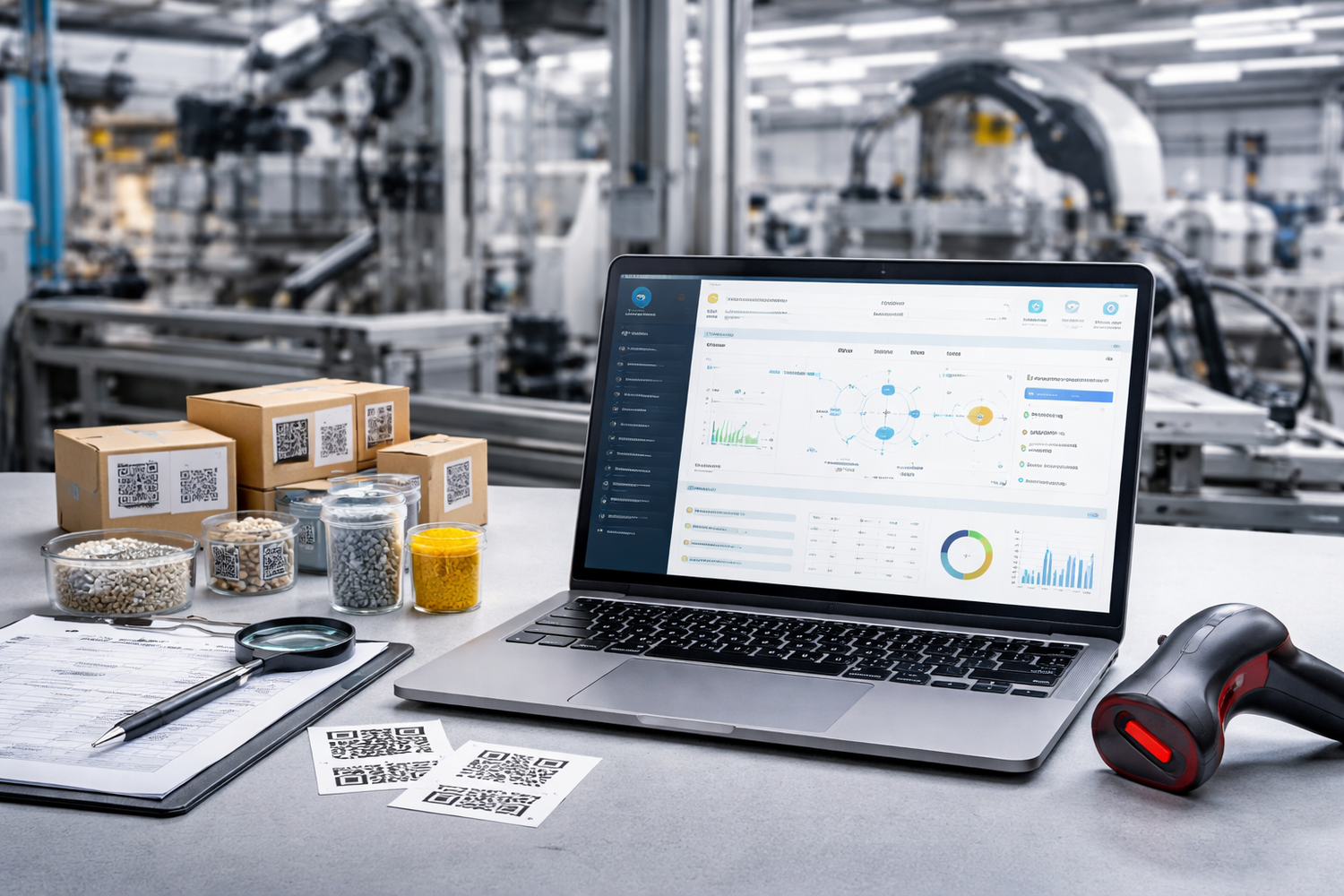
For a manufacturing company, it is not enough to know how much raw material is in stock and how much product has been produced. At a certain point, much deeper questions arise: which exact raw material batch was used to make a specific product, which products used problematic raw materials, which batches are still in stock, what has already been shipped to customers, and how to quickly trace the entire movement chain.
These are exactly the problems that traceability in manufacturing solves. For some companies, it is a matter of quality; for others, it is a requirement of internal control; for others, it is the foundation for stable production scaling.
In this article, we will look at what traceability is, what problems it solves in practice, where businesses most often lose control, what the logic of batch accounting in an ERP system should look like, and which tools manufacturing businesses need for real control over raw materials, semi-finished goods, and finished products.
What traceability in manufacturing is
Traceability in manufacturing is the ability to track the full path of raw materials, semi-finished goods, and finished products at every stage of movement: from receiving materials to production, transfer, write-off, return, and sale.
In practice, this means that a company can answer two key questions:
- Backward traceability — what exactly a specific product was made from.
- Forward traceability — where exactly a specific raw material batch ended up.
If a system does not allow you to quickly get both answers, traceability is effectively missing, even if the company formally “tracks batches.”
Why this matters not only for large manufacturers
It may seem that traceability is only needed in pharmaceuticals, food manufacturing, or industries with strict regulatory requirements. In reality, that is not the case.
Even if production is relatively small, the lack of traceability creates the same problems:
- It is impossible to quickly localize a quality issue.
- It is difficult to understand what exactly went into production and when.
- There is no transparent link between supply, output, and sales.
- The risk of material write-off errors increases.
- It becomes harder to control cost and batch balances.
- Any incident must be investigated manually and takes disproportionately more time.
The more complex the production, the more SKUs, shifts, semi-finished goods, series, and suppliers there are, the more expensive the absence of traceability becomes.
What problems traceability solves in practice
Situation |
What the business needs |
What traceability provides |
|---|---|---|
A supplier reports a problematic raw material batch. |
Quickly find which products used it. |
You can see the full chain from the raw material batch to products and sales. |
A customer files a complaint about finished product quality. |
Understand which raw material batches were used to make the product. |
You can move from the sale to the product batch and then to the material batches. |
There are discrepancies in balances or write-offs. |
Identify exactly where the error occurred. |
You can check the movement of a specific batch across documents. |
Purchasing needs to be planned. |
Understand the real demand for raw materials. |
Batch accounting and production reports provide more accurate control of demand and balances. |
Series, process batches, shifts, or internal production cycles must be separated. |
Record the company’s own batch logic. |
You can manually assign batch numbers during supply and production. |
Where manufacturers most often lose control
In practice, problems rarely begin with the complete absence of the concept of a “batch.” More often, the issue is that batch accounting exists formally, but does not provide real control.
The most typical weak points are:
1. A batch exists, but it is not linked to real movement
The company sees a batch number in a receipt document, but cannot quickly understand where that batch was used, which product it ended up in, and whether it has already been shipped to a customer.
2. There is no manual control where it is needed
Automatic write-off is convenient, but in real manufacturing, it is often necessary to deliberately choose a specific batch because of shelf life, customer requirements, process specifics, or a specific production series.
3. The batch exists only at warehouse level, but not at production level
In this model, it is visible that raw materials arrived as a batch, but it is not visible which batch was formed at the output of production. This breaks the traceability chain.
4. There are no proper reports
Without batch reports, even correct accounting remains “dead.” The data exists, but it is still impossible to answer business questions quickly.
5. Inventory counting breaks supply logic
If surplus stock is simply posted through inventory counting without a well-thought-out logic, the company loses information about the origin of the goods. For traceability, this is a critical problem.
What an ERP system must have for traceability to actually work
From a methodological standpoint, full traceability in ERP requires not just “batches in general,” but a specific set of capabilities.
What the system must have |
Why it is needed |
|---|---|
Batch accounting. |
So that the system tracks the movement of goods and materials not only by item, but also by specific batch. |
Automatic batch write-off methods. |
To define the system logic: FIFO, LIFO, or other rules. |
Manual batch selection in documents. |
So that the user can control the write-off, sale, transfer, or return of a specific batch. |
Manual batch number entry during supply. |
To preserve the supplier’s actual batch number or another external identifier. |
Manual batch number entry in production. |
To record the company’s own logic for finished goods batches: series, process batches, shifts, cycles. |
Reports for forward and backward traceability. |
To quickly move through the chain both from sale to raw materials and from raw materials to sale. |
Reports on batch movement and balances. |
To see the history of a specific batch and its current balance. |
How batch logic should work in a good ERP system
The correct logic looks like this:
- At the supply stage, the company either records the supplier’s real batch number or allows the system to create an internal number automatically.
- At the production stage, each finished goods line can either have its own batch number assigned or use an automatically generated system number.
- During transfer, write-off, sale, or return, the system either selects a batch automatically according to the chosen method or allows the user to manually choose the required batch.
- At the output, a complete movement chain is formed — from a specific raw material batch to a specific product batch and then to the sale or return document.
The key point is this: a batch should not be just a reference attribute, but a real control unit in documents and reports.
Practical example #1: a supplier reports a problematic raw material batch
Imagine a sauce manufacturer that receives a message from a supplier: one of the spice batches may have quality deviations.
Without traceability, the company starts a manual investigation:
- It searches for the receipt document.
- It compares dates.
- It reviews production documents.
- It tries to understand where the raw material may have gone.
- It separately looks for shipments.
This is slow, error-prone, and creates the risk of missing part of the related operations.
With traceability, the logic is different:
- The company finds the raw material batch code.
- It sees which product batches it entered.
- It checks whether there is still stock remaining.
- It sees what has already been sold, to whom, and when.
That means the issue is localized quickly and precisely.
Practical example #2: a customer complains about finished product quality
Now the reverse situation: the problem starts not with raw materials, but with a finished product that has already been sold.
What the business needs:
- Find the sales document.
- Understand which specific product batch was shipped.
- See which raw material batches were used to produce it.
- Check whether there are other sales involving the same set of raw materials.
This is exactly why backward traceability is needed — moving from the sale back to the raw material batches.
If the system supports this, the company can move quickly from the incident to the specific cause. If not, the investigation turns into a manual search through spreadsheets, documents, and employee memory.
Which reports manufacturing actually needs
For practical traceability work, it is important not just to have batches, but to have reports that answer business questions.
Report |
What it shows |
When it is especially useful |
|---|---|---|
Requirements Planning (MRP). |
Raw material demand based on production documents and balances. |
Purchase planning and shortage detection. |
Production Report. |
The overall picture of production output over a period. |
Operational production control. |
Product Batch Composition. |
Which raw material batches formed a specific product batch. |
Quality complaint analysis and production audit. |
Raw Material Batch Usage. |
Which products used a specific material batch. |
Impact analysis of problematic raw materials. |
Product Batch Movement. |
The full life cycle of a specific batch. |
Movement, balance, and related document control. |
Batch Balances. |
Which product batches remain in stock. |
Inventory and shipment management. |
Backward Traceability. |
The path from sale back to raw material batches. |
Investigation of incidents after sale. |
Forward Traceability. |
The path from a raw material batch to production, sale, and customer. |
Risk localization for problematic raw materials. |
Which industries need traceability the most
Traceability is most valuable where quality, process stability, series control, and the ability to quickly analyze deviations are critical.
It is especially relevant for:
- Food manufacturing.
- Confectionery production.
- Bakeries and bakery production.
- Beverage production.
- Cosmetics manufacturing.
- Chemical production.
- Pharmaceutical manufacturing.
- Dietary supplement and nutraceutical production.
- Feed production.
- Meat processing.
- Dairy production.
- Semi-finished goods production.
- Packaging.
- Furniture manufacturing.
- Light industry.
- Garment production.
- Metalworking.
- Mechanical engineering.
- Electronics and instrument manufacturing.
In essence, if it is important for a business to know what was made from what, where it went, and what exactly must be checked if a problem occurs, traceability becomes practically essential.
What properly organized traceability gives a business
- Less time spent investigating incidents.
- Faster localization of quality issues.
- More accurate material write-offs.
- More transparent production accounting.
- Better control of batch balances.
- A stronger foundation for production scaling.
- Fewer operational risks.
- Better process control.
How this is implemented in Skynum
In Skynum ERP for manufacturing, traceability is implemented through batch accounting, manual and automatic batch management, and reports that allow companies to analyze the movement of raw materials, semi-finished goods, and finished products at every stage — from supply to sale.
The system supports:
- Automatic batch write-off methods.
- Manual batch number entry during supply.
- Manual batch number entry in production.
- Manual batch selection in documents.
- Reports for forward and backward traceability.
- Control of batch movement, batch balances, and the composition of a specific product batch.
So this is not a separate “checkbox module,” but a practical tool for manufacturing companies that need real control over materials, products, and related risks.
Conclusion
Traceability in manufacturing is not about complex theory, and it is not a feature “only for large companies.” It is about a business’s ability to quickly answer critically important questions: what was used, where exactly, in what quantity, where it ended up, and what should be done if a problem occurs.
If an ERP system can provide these answers quickly and clearly, manufacturing becomes much more manageable. If it cannot, even good accounting will not save the company from chaos during real incidents.
That is why, for a modern manufacturing company, traceability is no longer an optional extra — it is an important part of the production management system.