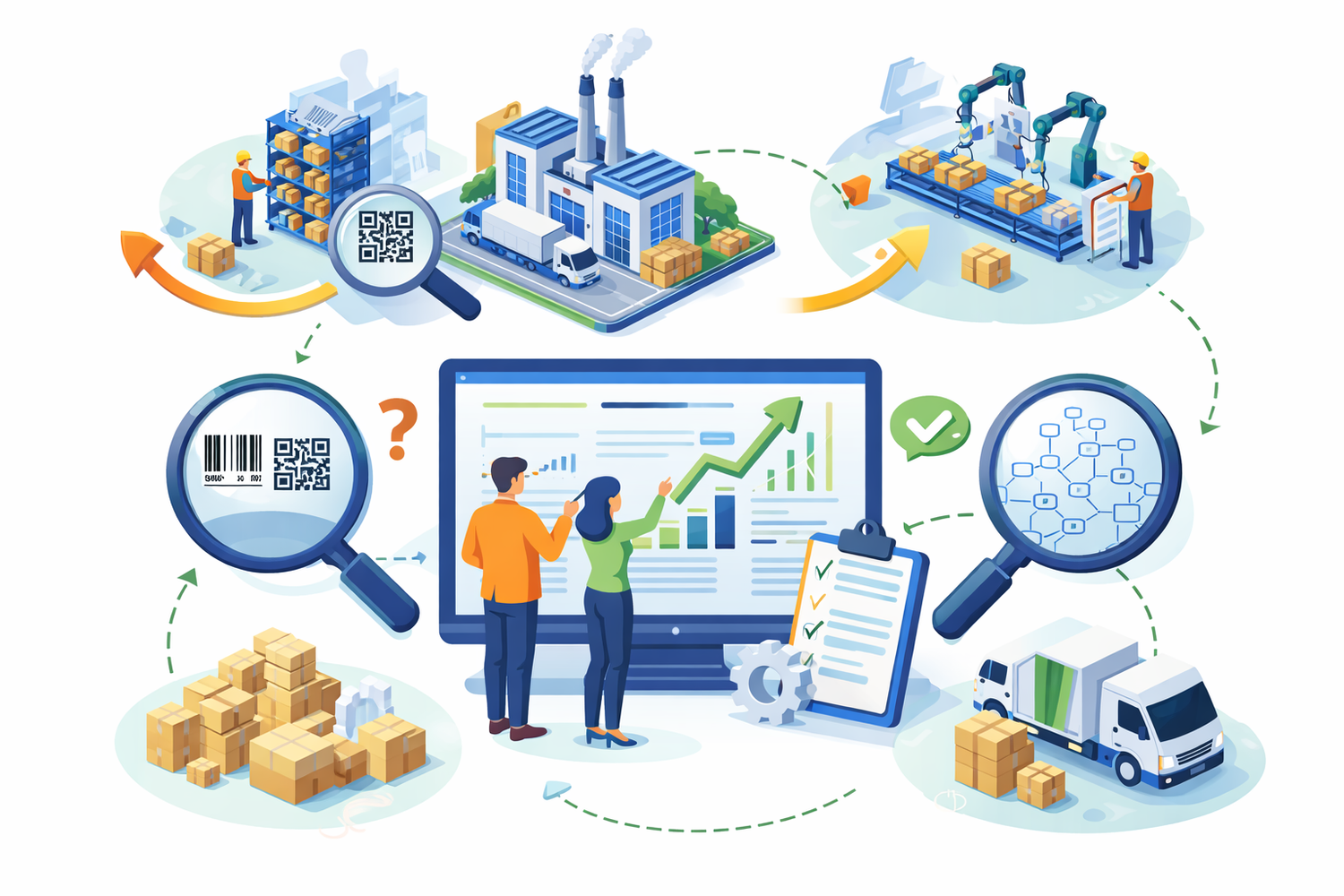
Skynum is expanding its capabilities for manufacturing companies: the system now offers a new level of batch handling that enables full traceability in manufacturing.
This is an important update for businesses that need precise control over the movement of raw materials, semi-finished goods, and finished products, transparent production accounting, fast deviation analysis, and the ability to respond quickly to quality-related issues.
What traceability in manufacturing means
Traceability in manufacturing is the ability to track the full path of materials and products at every stage: from raw material receipt to production, transfer, write-off, return, and sale of the finished product.
With this capability, a company can accurately determine:
- Which specific raw material batches were used to produce a particular product.
- Which products used a particular material batch.
- Which documents recorded the movement of a batch.
- What the current balance of a specific batch is.
- Which customers received products made from a specific raw material batch.
For a manufacturing business, this is not just an extra convenience, but a tool for managing quality, cost, inventory, and risk.
What Skynum already had and what has changed now
Skynum already supported batch accounting, multiple batch write-off methods, and a number of production reports. This new update does not start that logic from scratch — it develops it into a full traceability tool for manufacturing companies.
The system now allows users not only to maintain batch accounting, but also to manage batches more deeply in practice: record them during supply and production, manually select specific batches in documents, and build both forward and backward traceability chains.
How Skynum has expanded batch accounting capabilities
The new update adds tools that make batch accounting much more practical for real manufacturing operations.
Users can now:
- Enter batch numbers manually during supply.
- Enter batch numbers manually in production.
- Manually choose a specific batch in write-off, transfer, sales, and return documents.
- Build forward and backward traceability chains for batches.
- Analyze the movement of raw material and finished goods batches more deeply alongside production reports.
In essence, Skynum now makes it possible to build a complete chain:
Raw Material Supply → Production → Product Batch → Transfer / Write-off / Sale / Return.
What problems this solves for manufacturing businesses
Quality control
If an issue is identified with a specific raw material batch, the company can quickly determine which products used it. If a complaint is received about a finished product, the system can identify which raw material batches were used to make it.
Fast incident response
In the event of a claim, return, defect, or supplier notice about a defective batch, there is no need to spend hours manually searching through documents. The entire movement logic is already assembled in the system.
Transparent production accounting
Batch accounting makes it possible to see not only overall balances, but also specific batches, their movement, cost, and links to production and warehouse operations.
More accurate material write-off
A company can use either automatic write-off based on a configured method or manual selection of a specific batch in the document. This is especially important where series, shelf life, технологические партии? We need translate: production batches or process batches, and internal warehouse rules are critical.
More accurate inventory management
The company sees not just the stock balance of an item or raw material, but the balance by batch. This provides greater control when planning production, shipments, and purchasing.
Batch accounting as the foundation of traceability
Skynum already supported batch accounting with multiple write-off methods. That logic serves as the foundation for traceability in manufacturing.
Available methods include:
- FIFO — the earliest received batch is written off first.
- LIFO — the most recently received batch is written off first.
- Highest price from batches in stock — the batch with the highest cost is written off.
- Lowest price from batches in stock — the batch with the lowest cost is written off.
The new update extends this logic further and adds manual batch control and end-to-end traceability in manufacturing.
Manual batch entry and manual batch selection
The update in Skynum is not limited to automation alone.
Users can:
- Specify their own batch number when receiving goods from a supplier.
- Specify batch numbers for finished goods in production.
- Manually choose which batch to write off, transfer, sell, or return.
This is especially important for companies that work with real supplier series, internal production numbers, process batches, shifts, or batches with specific characteristics.
Which reports help with traceability
Skynum already included reports for production and planning, and the new traceability functionality significantly expands their practical value. These reports now help not only with production planning and output control, but also with analyzing the movement of specific raw material and product batches.
- Requirements Planning (MRP) — for planning purchases and identifying raw material shortages.
- Production Report — for monitoring production output over a period.
- Product Batch Composition — to see which raw materials formed a specific batch.
- Raw Material Batch Usage — to understand which products used a specific material batch.
- Product Batch Movement — to track the full life cycle of a specific batch.
- Batch Balances — for controlling finished goods batches in stock.
- Backward Traceability — from sale back to raw material batches.
- Forward Traceability — from a raw material batch to production, sale, and customer.
As a result, Skynum combines batch accounting, production documents, and reporting into a single control system that provides a complete picture of material and product movement.
Which manufacturing industries benefit the most
Batch traceability is especially valuable for companies where quality, process stability, series control, and the ability to quickly analyze deviations are critical.
It is particularly relevant for:
- Food manufacturing.
- Confectionery production.
- Bakeries and bakery products manufacturing.
- Beverage production.
- Cosmetics manufacturing.
- Chemical production.
- Pharmaceutical manufacturing.
- Dietary supplement and nutraceutical production.
- Feed production.
- Meat processing.
- Dairy production.
- Semi-finished products manufacturing.
- Packaging production.
- Furniture manufacturing.
- Light industry.
- Garment manufacturing.
- Metalworking.
- Mechanical engineering.
- Electronics and instrument manufacturing.
- Any manufacturing business where it is important to control batches of raw materials, semi-finished goods, and finished products.
If it is important for your business to know what was made from what, where it went, and what exactly must be checked when a problem occurs, this functionality is practically essential.
Why this matters for a modern ERP system
A strong ERP for manufacturing is not just about documents, inventory, and basic accounting. It should allow a business to see the real picture of the production process, control quality, manage risks, quickly identify cause-and-effect relationships, and support decision-making.
That is why traceability in manufacturing is one of the key capabilities of a modern manufacturing ERP system.
Skynum gives manufacturing companies not just an accounting tool, but a system that helps manage production more deeply, more accurately, and more transparently.
Traceability in manufacturing is now available in Skynum
The new functionality is already available to Skynum users.
If your business needs to control the movement of raw materials and products by batch, ensure transparent production accounting, and work quickly with quality-related issues, the new traceability capabilities in Skynum will become an important tool in your day-to-day operations.